Simply purchasing a domain and constructing a simple website on the internet isn’t enough to have a significant online presence. When it comes to establishing a powerful online presence, there are several factors to consider.
It’s critical to keep improving your business website and putting in the necessary web design and SEO work. Your website will take some time to establish a strong internet presence. Expect no drastic changes in a short period of time.
The Importance of Website Design
A good online presence is determined by a variety of elements. The design of a website is crucial, and it is the most basic part that must be addressed before achieving a website with millions of visits.
The design of your website may be both a strength and a weakness at the same time. A well-designed user interface will aid in achieving a higher conversion rate. A user-friendly website will quickly garner client attention and, as a result, business success.
Investing In Your Business Website
If you decide to invest in a superb website design, your company may make a significant profit. Make sure you choose a responsive web design service provider who can get the job done.
Robust Website Navigation
The navigation of a website is crucial. The navigation bar should be user-friendly and present a list of easily navigable web pages. Visitors are enticed by the site’s simple but straightforward navigation, which encourages them to return to the website.
Easy to understand Website Content
If your message is simple and clear, website visitors will remember your company for a long time. The elements of website design must convey the correct message to visitors.
Make sure you only apply it in the appropriate amount. You might also need services to convert PSD to HTML/CSS to improve the performance of the website.
By Overdoing design elements on your website, it will be tough to read and understand it. Visually cluttered pages will generate irritate your visitors and make them to leave quickly, resulting in a higher bounce rate. It is ideal to keep the content and visual elements simple so that web designers can simply include it into their designs. For guidance, you can always consult a web design company.
Increasing Website Engagement
Your web page design will look more enticing to your visitors if they are well-designed. With the help of a website design company, you can easily gratify visitors to the website since here is where client involvement begins. For this, it is mandatory to have a robust website design.
Improved Search Engine Optimization
Search Engine Optimization (SEO) may be improved by using HTML for specific business-related keywords on your website. Simply said, this implies your website will become more search engine friendly. Higher search engine rankings on Search Engine Result Pages (SERPs) is achieved when search engines such as Google, Yahoo, and Bing can crawl your page.
Keeping Brand Uniformity
If your company has a distinct logo that is used on all printed products, all of the elements of your business logo must be included into the website.
At all costs, your company’s identity must be recognizable by your target audience. If you mistakenly make little modifications to your brand while presenting it, it might cause consumers to become confused.
Conclusion
Business owners are able to create a user-friendly online interface on their websites with the help of modern website design. Your visitors can get useful information at any given point of the day with just simple clicks through your business website. Then website design agency that you choose to work with, will create a seamless roadmap of all the services that you provide in an elaborative manner for the visitors.
If you have a well-managed website for your business, your loyal clients will begin to rely on you. It increases customer trust, and they will utilize your products or services with complete confidence, even recommending them to their friends, leading in the development of a successful, prosperous, and revenue-generating business model.
Only roughly 34.4 % women are working at the world’s five largest tech companies, such as Google, Microsoft, and Apple. When it comes to recruiting women, the tech industry unfortunately lags behind the rest of the employment market.
For women, each day is like a new challenge because working women have more obligations than just home responsibilities to deal with. These are the modern times, and new elements have been added to women’s personalities, such as financial independence and the ability to handle greater responsibilities.
Working women must learn to manage their time, and this can be considered the main reason why there are less women in the tech industry.
Opportunities With Working From Home Model
In the aftermath of the COVID-19 pandemic, working from home has gone from a pipe dream to a reality for working women. The way we work has irrevocably altered, and it appears that there is no turning back.
Working from home became quite popular after the COVID-19 outbreak. Because of the outbreak, a number of remote workers claim that they are working from home. But on the other side majority of tech employees believe that their companies intend to make remote employment permanent. Because it brings more benefits than drawbacks. The majority of people appear to be pleased with the shift and would like it to continue, primarily because it saves time and money on travel. The advantages of remote work appear to exceed the disadvantages for employees as well. In fact, 97% of the remote workforce say they’d like to work from home for the rest of their careers. Working from home thus appears to be a better option for working women in the computer business than it has ever been. They may now effortlessly keep earning and handle childcare and household responsibilities while working from home in the IT industry.
Working opportunities For New Skill Set
Emerging working opportunities in niches like Artificial Intelligence, Machine Learning and Data science are increasing day by day. IT companies like Accrete Infosolution Technologies is hiring more and more Node JS developers, React JS Developers, Angular JS Developers. Thus, attaining expertise in coding languages like python, node, react, angular and native can help women get work in competitive IT spaces and provide them the opportunity to generate income while working from home.
Women can gain expertise in these latest technologies that are providing a plethora of working opportunities. The space becomes more suitable for women because now they can work from home and effectively manage their home and work responsibilities at the same time.
Hiring Based on Potential
Women in the workplace may be harmed by the present tendency of hiring based on prior experience. Applicants’ potential should be considered while hiring in the tech industry. To properly figure out who will be the perfect fit for management and executive-level jobs, tech companies should hire keeping in mind the amount of attributes like curiosity, engagement, and passion in the applicant’s attitude towards work. Hiring for future potential rather than recent experience empowers women to advance into positions they deserve and build a brighter future for themselves.
Men and women have various perspectives on things and bring different perspectives to the table. This allows for improved issue resolution, which can improve business unit performance. Consider how much power you’ll be able to harness by bringing together people of different genders. Moreover, Individuals anticipate differences in viewpoint and perspective when women are present, and they assume they will have to work harder to reach a consensus. That kind of pressure brings a win-win situation for everybody.
Conclusion
Because the tech industry is expanding at such a rapid rate, diversity in hiring is sometimes disregarded. Rather than assembling a diverse pool of candidates of various genders and from different backgrounds, some companies hurry in the recruitment process and hire the first perfect fit they find. Thus, this hasty method prevents the recruitment of more women in the tech industry. Accepting more women into the interview process not only provides a platform for working women but also helps to ensure a future diversity of high-quality ideas in the business. As a result, firms must take action to assist female technologists in developing their own talents, with an emphasis on artificial intelligence, machine learning, data analytics, and cybersecurity.
React Native vs React JS are both the most developing and commonly preferred JavaScript used to develop various applications for Android, iOS, web, windows, etc. However, there could be many differences found. For quite a while now, React Native and React JS has been trending in IT development.
Before jumping right into the differences, it is essential to have a little knowledge of both React Native and React JS. So, let’s go complete each of them and comprehend their features.
Understanding React Native
React Native is a cross-stage mobile structure that utilizes React JS for building different applications and sites. React Native has been effectively received by many organizations worldwide, including Uber, Microsoft, Facebook, and is utilized across an entire scope of businesses.
Although React Native uses React JS, it cannot be considered the new version of React JS. Instead, it is just controlled by React JS and allows designers to utilize many UI segments to rapidly order and dispatch iOS and Android applications.
Understanding React JS
React JS framework offers effortless solutions for some of front-end programming’s most steady issues, permitting you to quickly fabricate dynamic and intelligent web applications. It’s quick, adaptable, impressive, and has a vigorous designer community that is fast developing.
Facebook created React.js to address its requirement for a dynamic and high-performing User Interface (UI) which is worked around segments. Every one of these segments is a JavaScript work characterized by the user.
The business viewpoint of React Native and React JS
React Native
One of the greatest USPs of building applications and sites utilizing React Native is creating platform-specific code. When you use React Native after you hire ReactJS Developer to fabricate an application, the system naturally identifies the stage it’s being run on.
Since the more significant part of the code present in React Native is JavaScript, it gets simpler for a front-end engineer to make an application rapidly. This simple ease of use and expectation to learn and adapt empowers non-software engineers to make applications effortlessly.
This has persuaded a sort of the change in the manner applications and sites are made today. So all you need is a little thought and an arrangement to execute the right plan.
React JS
One of the USPs features of React JS app development is its capacity to acquire quick speed for the applications and sites created, utilizing the DOM or Document Object Model. This is because JS makes an in-memory information structure cache that registers the subsequent contrasts and refreshes the program’s shown DOM flawlessly.
React JS is well-known for providing speed to applications. This gives React JS app development a considerable margin to stand out and become successful in its ability in contrast with others.
React JS presented the idea of segment-based design, which upholds the reusability of segments, and accordingly, saves a considerable measure of time. Moreover, since React JS is fit for server-side delivery, it surrenders gigantic heads to the general SEO technique of the site.
Now that you have differentiated between the two let’s scroll down and point out the main differences.
Key differences between React Native and React JS
React JS can be depicted as a base subsidiary of React DOM for the web stage. On the other side, React Native is a base subordinate in itself, which implies that the grammar and work process continues as before, only the parts change.
React Native is intended to give your mobile applications a local feel, whereas, React JS is ideal for building dynamic, high-performing, responsive UI for your web interfaces.
React JS uses code parts, which saves a ton of significant time, while React Native uses its UI segments and modules, permitting hybrid applications to deliver locally.
In React JS, virtual DOM is utilized to deliver program code, while in React Native, local APIs are being used to provide segments in mobile.
React JS utilizes a JavaScript library and CSS for animations, though, React Native accompanies built-in animation libraries.
React Native has an underlying Navigator library for exploring mobile applications; then React JS utilizes React-switch to explore site pages.
The applications created with React JS provide HTML in UI while React Native uses JSX for delivering UI, which is the only JavaScript.
Now let’s note down the advantages and disadvantages of React Native and React JS, so that differences between the two become all clear and understandable.
React Native is free and open-source, resulting in an enormous group of programmers attempting to work on the system continually.
React Native has every one of the fixings to guarantee a great beginning if you fuse it into your mobile application.
React Native’s features are a noticeable factor in the top decision for big business mobility arrangements.
Cons
Because of the absence of local libraries, React Native can hinder the development interaction if the application has heavy functions.
The main complication with React Native is that it requires some time investment to introduce the runtime for devices and gadgets.
Pros and Cons of React JS
Pros
React JS has Code stability with a unidirectional data stream, allowing single direction information binding to guarantee that the progressions made in the small segments don’t affect the large segments.
Thus, React JS applications are simpler to keep up with as their code is exceptionally steady and secure.
As React JS uses the tree reconciliation process, this cycle makes the web application work quicker as there is no compelling reason to refresh the entire DOM passages consistently.
Cons
Using React JS expands cost and time overheads as sometimes it needs to download another react-empowered library.
Navigating data within React JS is quite difficult and complex, so learning React JS might take significantly more time for a new programmer.
Conclusion
Both React Native and React JS have their own set of features unique to them. Therefore, it is best to understand the project requirements before choosing the programming language to use.
In the software industry, developers have many choices to decide which programming language they want to use to develop a web-based software. While some languages will keep coming and going forever, some others have survived the test of time. As a developer, you do not need to participate in a race with a wooden leg; hence it becomes essential to choose a programming language that provides advanced functionality while being versatile at the same time.
In this article, we are comparing Node.js and ASP.NET (Core). Both are renowned and publicly available programming languages and provide fast, scalable, robust, and secure development process. Though, respectively language has its own set of advantages and disadvantages that gets better with every release. Therefore, the choice of a programming language will depend on the requirements of the project. For example, ASP.NET (Core) is a limited environment, while Node.js has various tools available without any additional charges.
Both programming languages have some fantastic features that fulfill your project or business requirements. Let us compare both programming languages for a set of features below.
Basic of Node.js vs ASP.NET Core
Developed as an alternative to Server-side scripting in JS, Node.js can work for both frontend and backend development as it is a JavaScript-based programming language and is compatible with all languages based on JavaScript. In addition, there are prewritten codes available in the form of modules within packages that allow you to write code faster and more professionally. There are almost a million packages available in the Node.js library. There is even an automatic lock-file mechanism that allows you to secure new dependencies.
.NET Core is entirely different from Node.js as it is based on the C# programming language and can be used only for .NET projects using languages such as F# or C++. Similar to the Node.js libraries, there are libraries available for .NET Core with prewritten code with support for data structures. These libraries include security, encryption, and database access. For graphics rendering and database connectivity, class libraries are used.
Synchronous & Asynchronous Processing Models: Node.js vs .NET Core
Node.js and .NET Core have entirely different models for processing. Node.js is an asynchronous platform and can handle multiple requests simultaneously without blocking them. Although the code execution is done on the main thread, other parallel threads perform other tasks. This increases the efficiency and speed of processing in Node.js solutions, even if the data set is large.
.NET Core is also an asynchronous platform where each request is processed on a separate thread. Each I/O request does not block the threads. This makes .NET Core one of the fastest web frameworks available across multiple programming languages.
Performance of .NET Core vs Node.js
Having an asynchronous model, solutions built using Node.js have a good performance without being too heavy compared to the other solutions. As per a study conducted by Nodejs.org, almost 50% of the companies realized better app performance after switching to Node.js for their technology platform.
In other studies, it has been originating that .NET Core has a better performance than Node.js. However, this shows that one programming language cannot be considered better than any other, as it all depends on the business requirements.
Reliability, Stability and Security
In these criteria, .NET Core is a clear winner as it is much more secure and reliable, and solutions developed on this platform using C# are robust. However, for complex enterprise software developed using Typescript, Node.js is a more reliable alternative.
Benefits of using .NET Core:
It is easy to work with, and as a developer, you will have certain limits that are precise yet flexible if you operate using the correct processes.
.NET Core allows developers to create programs using less code and even optimize the code structure, thanks to reduced code lines. In addition, less development time means less expenditure in developing the solution, bringing .NET Core much closer to Node.js when developing speed.
Maintenance of large applications built over .NET Code is more effortless than Node.js. .NET Core is a platform-independent language. It allows developers to create microservice applications that are self-sufficient and autonomous.
Benefits of using Node.js:
js is a full-stack JavaScript that can be used to develop server-side and client-side applications that are interpreted using the V8 JavaScript engine developed by Google. This engine compiles JS code into machine code which makes the whole process fast and efficient.
The runtime environment supports non-blocking I/O operations, which speed up the execution of code.
Platform Support and Stability of Node.js vs ASP.NET Core
.NET Core was a pure Windows-based platform till 2018, after which it was upgraded to run on Linux and macOS. Node.js is platform-independent and is officially supported by Windows, macOS, Linux, IBM AIX, FreeBSD, and SmartOS.
When it comes to scalability, both Node.js and .NET Core are highly scalable platforms and fit into the microservices architecture very well. In addition, Node.js is perfect for developing distributed systems.
.NET Core vs Node.js? It will be easier for you to decide the programming language if you know what kind of software or app you want to develop. If you are still unclear, give us a hint and we will consult you to make the best decision based on your project requirements.
Using a Redis object cache for WordPress is a great way to make your WordPress website faster, especially if you’ve already gone through the “Making WordPress Fly” series of tutorials (noted that one commenter there actually mentioned Redis). You’ll need an Ubuntu 14.04 VPS with WordPress already setup on it. You can get an Ubuntu VM here if you don’t have one. You don’t have to use the aforementioned HHVM setup for this tutorial. However, using both HHVM and Redis object caching will give you the fastest load times. I will be releasing another article in the near future about improving HHVM stability for production deployments by using a PHP-FPM failover and an upstart script which does automatic respawning after a crash, something HHVM does not do by default on Ubuntu. Back to Redis – Redis is possibly the best way at present to implement the WordPress object cache. For a long time I have been a proponent of either APC or Memcached in combination W3 Total Cache for the object cache in WP.
WHY USE A REDIS OBJECT CACHE FOR WORDPRESS?
During a recent server setup for a new website (My French City) I came across an issue. Caching using APC or Memcached helped with front end speed, but the admin area was painfully slow. This site was a multisite install with domain mapping and hundreds of plugins. There were simply too many queries going on in the backend for it to be snappy. After some searching I discovered that implementing Redis to back the WordPress object cache was a great way to improve backend speed. After implementation it turned out it did a better job on the frontend then W3TC and Memcached, which was a pleasant surprise. HHVM does a great job of speeding up PHP and MariaDB 10.1 is also fast. But on a heavy site like this with lots of plugins, database queries are still the issue. Redis is an elegant NoSQL datastore solution to this problem.
A Redis object cache can be implemented in just a few commands on Ubuntu 14.04. Assuming you already have a working WordPress install (LAMP, LEMP , etc.) the process of getting redis working with WordPress is easy. First connect you your instance via SSH. Once connected:
1
2
sudo apt–get update
sudo apt–get install redis–server php5–redis
Now Redis is installed. To configure a Redis object cache for WordPress there are a few small changes we need to make. Open up /etc/redis/redis.conf then add these two lines at the bottom:
1
2
maxmemory1024mb
maxmemory–policy allkeys–lru
Now you’ll need to make some changes to WordPress. You’ll need to grab this file. Written by Eric Mann this file will allow WordPress to use a Redis object cache for awesome speed improvements. Once you’ve downloaded that file, make sure you disable W3TC object and database cache if you are using either. Now that Redis is running (and PHP knows how to connect to it), it’s time to tell WordPress to use our Redis object cache. You need to open wp-config.php and let WordPress know what host and port Redis runs on, and add a salt to keys. Add these lines:
Then place the file in you downloaded above in webroot/wp-content/object-cache.php, where webroot is the directory your website files are located within. Once this is done make sure the redis-server is running using sudo service redis–server status . Now you WordPress site is using a Redis object cache. You should notice significant speed gains once you click through a few pages and the cache is populated with queries. If you want to view the Redis console to see what kind of data is being stored run this command: sudo redis–cli monitor . That will show you a verbose look at what is going on in your Redis cache.
Unfortunately I do not have a control before and after for the speed difference. However here is a Pingdom load test of a page on this website:
I will be writing more about this in the future. Please leave your thoughts or any contributions in the comments below. At that time I may include more detailed information on the performance gains achieved using Redis object cache with WordPress.
Why JavaScript is The Heart of Programming Language?
70% of software developers prefer using JavaScript for web development. (Statista)
JavaScript is used as a client-side programming language by 97.1%of all the websites. (W3Techs)
JavaScript has become widely popular and many tech giants are taking advantage of it. From the many JavaScript frameworks, Angular and React are amongst the top ones, which is generally prefer by the software developer.
But, choosing one from both of them is a difficult thing.
React vs. Angular is a never-ending debate. However, this post will not help you to select the best one, neither other articles available on the internet, but will surely guide you with the complete knowledge that suits your project the best.
Let’s get started.
Angular vs React: Brief Overview and History
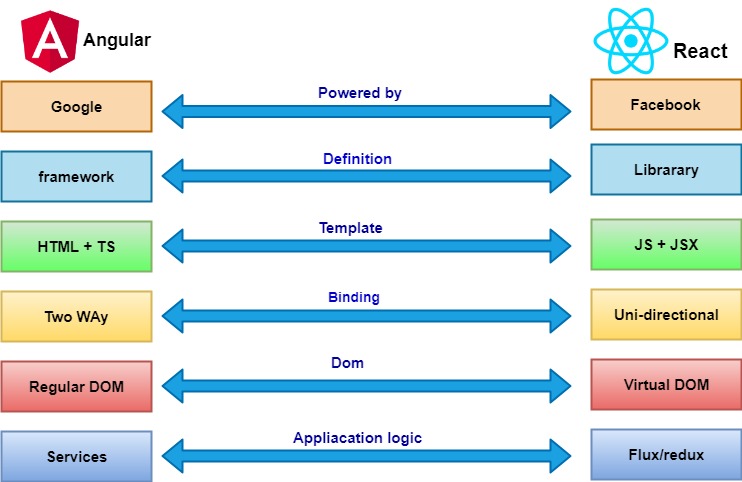
Image of React vs Angular
React
React JS is an open-source JavaScript library used to build a UI component for Single Page Application. It is backed by Facebook and used in products like WhatsApp & Instagram.
Other than Facebook, leading tech brands like Amazon, Pinterest, Airbnb, Twitter, Udemy, Paypal, Reddit, Tumblr, Walmart and many more are using React for web development.
Facebook even came up with the React Native for developing native mobile apps using JavaScript and React.
Angular
Angular is a Type-Script-based open source Javascript framework for web and mobile development. Backed by Google, it is an enormously popular front-end framework for web development.
Moreover, it came a decade ago in 2010, then to pace up with the latest technologies, Angular keeps rolling up with new upgrades at regular intervals. The latest version Angular 11 has an enormous number of features and functionalities.
Performance: Which is Better?
React
React.js uses virtual DOM (Document Object Model) which enables to access and modify the document content, layout, and structure; it exists entirely in memory. This virtual DOM is light in weight; thus reduces the load on the browser.
React reuses the code components, which doubles the productivity and optimizes the code practice.
For instance, you just want to update the contact number in your profile, DOM updates the entire tree structure of HTML tables until it reaches the needed data, while virtual DOM updates only the contact number without updating the entire HTML. This results in faster performance – no matter the size of the app.
Angular
Angular works on real DOM which makes the app slower while dealing with tons of data requests. However, Angular uses elements like Shadow API to make the app work fast. A wide range of other angular development tools and practices are available to build Angular apps faster, better, and to monitor performance.
Architecture and Structure
React
React.js is all about components; it builds UI by breaking them into components
React is made up of multiple components and each component has logic and controls.
Some of them include:
Redux
Babel
Webpack
Their codes are readable and logically structured. React provides only view and model layer- controller is added as per the usage from other libraries.
Angular
Angular is a framework that provides a complete set up to start with the application. Angular mobile first development provides no need to look into libraries, routing solutions, and structure; simply start building.
Angular is based on three layers: model- view – controller. In Angular, the application is broken into different files enabling to reuse of the components in a different part of an application.
Bundle Size: Does Size Matter?
React
File size matters to run a large and complex application. Compared to Angular, the bundle size of React is small. The smaller the file, the faster it works. React uses webpack to split the code into smaller parts to reduce the bundle size.
Angular
Angular apps generally have bigger bundle sizes when compared to apps written using other JavaScript frameworks. It does not include the entire bundle of Angular framework in the user’s app. Many compression tools and bundle analyzers for Angular are available to reduce the size but the developer needs to perform some extra optimizations.
Learning Curve: Which is Easy?
React
Are you good at JavaScript? If yes, then learning React.js is not difficult for you. As this framework is quite simple, you can make the app easily.
Developers may find it difficult to learn at the initial stage but since there are no logical structures to learn – no complexities, it is a favorable tech stack.
New updates are rolled out frequently and react even provides useful resources, making it easy for the newbies to develop an application without any hassle.
Angular
Angular is quite difficult to understand compared to react. Since it has a huge library, learning all the concepts is quite time-consuming.
It provides resources to solve complex issues but there are some syntax and components to learn which is quite unavoidable.
Although TypeScript is similar to JavaScript, developers need to put some extra efforts.
Unidirectional or two direction Data Binding?
React
React supports one-way data flow, which means the application’s data flows in a single direction, and only the model can change the app’s state.
The developers cannot alter the UI elements without updating the model state. One way data binding makes code more stable provides a better overview and also makes debugging of an app much easier.
Angular
Angular development advantages includes supporting bidirectional data-binding which means sharing the data with a component class and its template. If you change the data in one place, it will affect elsewhere.
This two-way approach provides a well-organized coding structure, making the framework more flexible and developers can hassle-free work with.’
Market Share and Trends
Angular vs React development speed varies but both frameworks are highly popular; both of them are highly used by the developers but the demand for React is increasing every year.
Let’s see how:
According to Statista’s, world-wide developer survey, React.js is used by 35.9% of developers and Angular is used by 25.1% of developers.
React has 160k stars on GitHub, and Angular has 59.5k stars on GitHub.
The npm trends shows more downloads for React than Angular. Google Trends also reports more searches for React across the world.
As per JetBrain’s developer ecosystem 2020 report, React is the most popular front-end development framework.
Community and Support
As React is developed by Facebook and Angular is maintained by Google, both of these frameworks has huge community support. Both frameworks provide updates and releases frequently. Software developers and designers collaborate and contribute frequently to increase the credibility and reliability of the framework.
We have pointed out the majority of the comparison needed to select between react and Angular. With this comparison, you might have got a clear scenario of React and Angular.
Let’s quickly have a look at their advantages.
Advantages of Angular
Open Source
Reusable Components
Can be customized easily
MVC pattern simplified
No pre-requisite knowledge is required
Unit Testing ready
Search-Engine Friendly
Advantages of React
SEO friendly
Virtual DOM
Simple to migrate
Easy Debugging
Boosts Performance
Simple User Interface
A Quick Comparison: React vs Angular
Factor
React
Angular
Release Date
2013
2010
Backed By
Google
Facebook
Language
JavaScript
Type-Script
Learning Curve
Less
High
Architecture
Component-Based, Flexible
Component-Based, Fixed
Data Binding
One-Direction
Two-Direction
Dependency Injection
Not supported
Supported
Type
Library
Framework
Compatibility
Backward
Full-compatibility
Performance
High
High
DOM
Virtual
Real
Ideal for
Dynamic apps
Large web apps
Companies using
Facebook, Uber, Netflix, Twitter, Walmart, etc.
Google, Google apps, Forbes, Wix, etc.
When to Use React?
If your developers are hands-on with JavaScript, HTML, and CSS
If you have a complex and huge app to develop
If you’re developing computational apps, dynamic apps, single-page apps, native mobile apps
When to Use Angular?
If you know Typescript, Java, and a previous version of Angular
If you’re ready to spend more time learning syntax and components
If you’re planning to develop low to medium level complex apps
If you need a large scale, feature-rich application
If you’re planning to develop enterprise software, hybrid apps, or progressive web apps
What’s Your Take? Angular or React?
Both the framework has its own competence, both has its pros and cons. Although React seems to be simple, you have to learn other JavaScript tools and frameworks. On the other hand, Angular is powerful and offers comprehensive web development though it is quite complex.
Both frameworks have a great support community and are regularly updated with better features and functionalities to provide the best user experience.
Ultimately, choosing Angular vs React depends on your personal preference, size of your project, requirements, team size, budget, etc.
Still, if you can’t decide, which the best for your business is, you can hire react js developers or hire angular developers. With their expertise, they will help you to build your application right from the requirement of development.
By clicking “Accept All Cookies”, you agree to the storing of cookies on your device to enhance site navigation, analyze site usage, and assist in our marketing efforts